
Blessed be the God and Father of our Lord Jesus Christ! According to his great mercy, he has caused us to be born again to a living hope through the resurrection of Jesus Christ from the dead, to an inheritance that is imperishable, undefiled, and unfading, kept in heaven for you, 1 Peter 1:3-4.
Read that verse again, focusing on the words written in bold.
With Resurrection Sunday approaching, many of us are reflecting on what this verse means. As believers we are born again to a living hope that will never leave or forsake us. Yet, do we really understand the profound implication of these words? In essence, that all depends on our definition of hope and what we put our hope in.
In today’s world, we are facing many situations that are in need of a redeeming hope. Crime, corruption, injustice and war continue to plague humanity. In response, some throw their hands up in despair, while others hold on to hope.
In the secular world, hope is often equated with a positive feeling or state of mind. But the Bible teaches us that hope is much more than being optimistic. In Old Testament Hebrew, hope is translated as the word tiqvah, which means something that is expected. More specifically, this word is defined as a strong woven cord, or line.
Rahab’s Hope
In the story of Jericho, we see the word tiqvah (hope) being used in an amazing way. An unlikely prostitute named Rahab, places her faith in the God of Israel. In turn, she risks her life to hide the Israelite spies on her roof. Her expectation (hope) is that she and her family will be given protection when destruction comes. To secure this hope, however, there’s something important she had to do first.
Joshua 2:18 KJV says:
Behold, when we come into the land, thou shalt bind this line (tiqvah) of scarlet thread in the window which thou didst let us down by.
This verse could be translated as: Thou shalt bind this HOPE of scarlet thread in the window. In order to receive salvation from the destruction of Jericho, Rahab had to act on her faith. She had to put her hope in the promise she was given.
Later in verse 21, Rahab secures her hope.
And she sent them away, and they departed: and she bound the scarlet line (tiqvah-hope) in the window.
This scarlet line (cord, hope) described in the story of Rahab and Jericho mirrors our salvation through Jesus Christ. As Christians, we must act on our faith by putting our trust in the Savior. No matter what disaster comes, we have that secure scarlet cord of hope to grab hold of. Even if our material world is destroyed–even if our very bodies succumb to physical death, we are covered by the blood of Christ. Our redemption is sealed. This is the hope that can never be taken.
There are some great examples in history which remind us that hope is more than a feeling. In fact, the true hope of eternal salvation guides the actions of those who fully understand its meaning.
Hope in the Midst of War
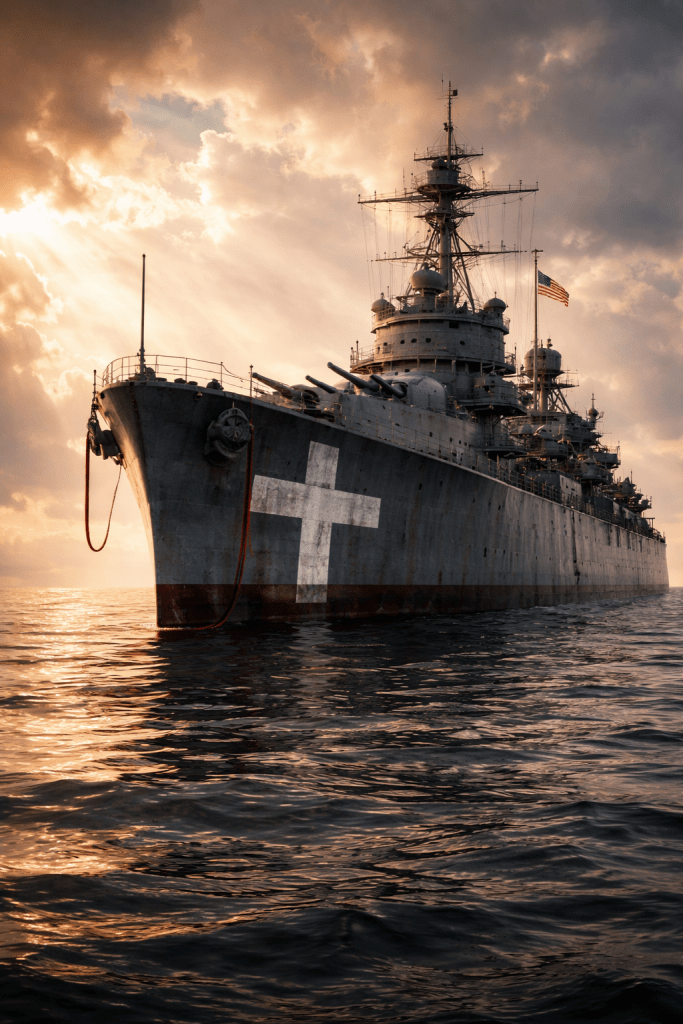
Father Thomas Conway was the last chaplain to give his life for his flock during World War II. He was on board the USS Indianapolis on July 30, 1945 when it was hit by two torpedoes from a Japanese submarine. The ship sank in twelve short minutes, taking the lives of 300 men with it. Nine hundred men survived the initial attack and sinking, only to be stranded in shark infested waters with virtually no supplies. Because of the secrecy of the mission and errors in communication, help would not arrive for the sailors until four days later.
During that trying time, hope became difficult, if not impossible to grasp. But there was one man who would not let it fade away. Father Conway swam among the men scattered in the water for three and a half days. Some had been burned by the ship’s fuel, while others were delirious from heat, thirst, fevers, and exhaustion. Sharks circled the terrified and injured men as they cried out for help.
Thomas Helms, in his book, Ordeal by Sea, wrote, “Father Thomas Conway swam from group to group, never stopping to rest, praying with the men, encouraging those who were frightened, trying to reason with the maddened. His faith and his prayers gave solace to many.”
Lt. Commander Lewis L. Haynes, survivor of the USS Indianapolis, told the Saturday Evening Post about the hopelessness of the situation and how Father Conway strengthened the men.
“All thoughts of rescue are gone, and our twisted reasoning has come to accept this as our life until the end is reached. A life with nothing but the sky, a shimmering horizon and endless wastes of water…But we have not lost everything. To the contrary, we have found one comfort – a strong belief to which we cling. God seems very close. Much of our feeling is strengthened by the chaplain, who moves from one group to another to pray with the men. The chaplain, a priest, is not a strong man physically, yet his courage and goodness seem to have no limit.”
Certainly, the situation of these men seemed hopeless. Over the course of several excruciating days and nights, the 900 survivors died off in droves. Many drowned, but others experienced hallucinations from drinking sea water. Confused sailors swam away to islands that didn’t exist, while sharks picked off men with bleeding wounds.
Nonetheless, Father Conway continued his mission of sharing the gospel. One survivor said, “He kept working until he was exhausted…He made us believe that we could be rescued.”
After many days of ministering, Father Conway became so worn out that he succumbed to delirium, eventually slipping into a coma. Sadly, he would not survive. Nevertheless, that didn’t mean he lost hope because his expectation was for something much greater than an earthly life. This is why he was able to share the gospel up to the very end.
He could have put his hope in getting back home.
He could have put his hope in seeing his loved ones again.
But these things were not secure or eternal. Father Conway set his eyes on a hope that couldn’t be taken away. Whether in delirium, or death, this was an expectation that was always there- one he had been waiting for since he received Jesus as his Lord and Savior. Knowing this, he was able to fight the good fight until he took his last breath.
Though Father Conway perished at sea, rescue eventually came for the men of the USS Indianapolis. Of the 1,195 who were originally on board, there would be only 316 survivors. But miraculously, the number 316 tells a story of hope.
John 3:16 declares,
For God so loved the world, that he gave his only Son, that whoever believes in him should not perish but have eternal life.
Eternal life is the strong cord of hope that Christians should always cling to. If we put our hope in this truth, we will be able to face even the worst disasters.
We can put our hope in the economy, leaders, elections, family, health, a better job, or earthly things that can be lost. While there is nothing wrong with hoping or praying for good outcomes, we must always remember that we can lose these things.
Yet there is one hope we can never lose– our salvation in Jesus Christ.
Rahab put her hope in something eternal. For the Lord your God, he is God in the heavens above and on the earth beneath, Joshua 2:11.
Lord Jesus, our hope is not in this world. Instead, our scarlet cord is bound to the truth that you give us eternal salvation in a sinking world. Your blood has guaranteed this promise and nothing can separate us from it.
How does knowing that we have a secure, eternal “rope of hope” help us face the troubles of this life?
I hope this blogpost encourages you this Passover season. The angel of death has PASSED OVER us because of the scarlet rope we cling to. Jesus Christ, our Redeemer, is our greatest hope in all things. Until we meet our Savior, let’s face the world’s challenges with courage knowing that whatever happens, we have the IMPERISHABLE PROMISE of eternal life.
 Revelations About Israel and the United States