
Perhaps one of the greatest challenges we face as human beings is learning to keep our minds focused on what is not only positive, but also true. Our thoughts can easily become consumed by fear, worry, doubt, and the countless uncertainties of life. Before we even realize it, we can find ourselves dwelling on things that have not happened, may never happen, or are completely false.
Of course, there are times when bad things do occur. Perhaps we lose our job, get into a car accident, are diagnosed with cancer, or a loved one passes away. It’s only natural for our minds to wrestle with experiences that are deeply upsetting, painful, or even traumatic. God never intended for us to pretend that these difficulties don’t exist or to ignore the emotions that accompany them.
We may not always have control over what happens to us, but we can learn to be intentional about where we allow our thoughts to linger. God’s Word teaches us that we are not meant to allow our minds to wander aimlessly or be controlled by our circumstances. Instead, we are called to fix our eyes on Jesus, the author and perfecter of our faith (Hebrews 12:2), and to deliberately direct our thoughts toward what is true, honorable, right, pure, lovely, and worthy of praise (Philippians 4:8).
You’ve probably heard the expression, “Don’t dwell on it.” In other words, don’t allow your mind to become consumed by negative thoughts or remain fixated on something that only brings you down. When we continually dwell on thoughts fueled by fear, anger, bitterness, or discouragement, we do more than exhaust ourselves mentally and emotionally. We begin to rob ourselves of the joy, peace, and hope that God desires for us to experience. But perhaps even more dangerous is when we allow our thoughts to be shaped and controlled by things that are nothing more than lies.
Recently, I came across a Hebrew word study that gave me a much clearer understanding of how we can train our minds to focus on what God wants us to know and believe, rather than allowing our thoughts to be dominated by things that keep us in a depressed and hopeless state.
The study centered on the following verse:
Thou wilt keep him in perfect peace, whose mind is stayed on thee: because he trusteth in thee, Isaiah 26:3.
The phrase “perfect peace” carries incredible significance. In the original Hebrew, the word shalom actually appears twice, emphasizing the fullness and completeness of the peace God provides. In effect, the verse could read, “Thou wilt keep him in peace, peace, whose mind is stayed on thee.”
In Hebrew writing, repeating a word is a way of placing special emphasis on its meaning. It’s as if God is saying, PAY ATTENTION! And there’s a very good reason for that emphasis, as we’re about to discover.
As Christians, we know that Jesus is the Prince of Peace. But did you know that Scripture also tells us that He Himself is our peace? Consider these verses:
For he himself is our peace, who has made us both one and has broken down in his flesh the dividing wall of hostility, Ephesians 2:14.
Peace I leave with you; my peace I give to you. Not as the world gives do I give to you. Let not your hearts be troubled, neither let them be afraid, John 14:27.
I have said these things to you, that in me you may have peace. In the world you will have tribulation. But take heart; I have overcome the world, John 16:33.
Therefore, since we have been justified by faith, we have peace with God through our Lord Jesus Christ, Romans 5:1.
The Hebrew word shalom means much more than simply the absence of conflict or trouble. It carries the ideas of completeness, wholeness, soundness, well-being, health, and prosperity.
After reading the verses above, as well as the definition of peace (shalom), it may seem like a believer is never supposed to experience sickness, financial difficulties, or hardships in life. It would appear as though we should never get upset, become rattled or frightened.
Well, I’m here to admit that sometimes I do lose the peace that Jesus has given me. In fact, the 2026 midterm elections just passed and it goes without saying that I found the results beyond disappointing. I am deeply concerned about the direction of our country, particularly when it comes to lawmakers who support policies and ideologies that conflict with biblical morality and the constitutional principles upon which our nation was founded. These are serious problems and I have definitely found myself getting down in the dumps about everything that has transpired.
Even though I might get down about these things, however, as soon as I make a real effort to give these burdens to Jesus, my whole attitude changes. When I stop and let the Lord have control of my worrisome thoughts, I begin to get back the peace that I surrendered to the enemy.
As followers of the Prince of Peace, we cannot allow the circumstances unfolding around us to consume our thoughts and rob us of the peace God has already given us. Instead, we need to fix our eyes on the One who remains sovereign over everything that happens in this world. Rather than becoming overwhelmed by all the “what ifs,” we should remind ourselves of what GOD CAN DO! Even when circumstances seem to be moving in the wrong direction, Jesus can use those very challenges to draw us closer to Him, strengthen our faith, and show us how to be a light in the midst of darkness.
Think for a moment about the night the Titanic sank into the freezing waters of the North Atlantic. Those who managed to escape aboard the lifeboats witnessed a tragedy of unimaginable proportions. Surrounded by darkness, they watched helplessly as the great ship disappeared beneath the ocean’s surface. Yet amid the horror of that night, survivors also recalled something remarkable about the sky above them. It was a moonless evening, and the stars were shining with extraordinary brilliance.
What a striking contrast! While tragedy was unfolding in the icy darkness below, the heavens above were filled with countless points of light. The stars had been there all along, but against the darkness of that moonless sky, their brilliance was all the more noticeable.

I believe there’s a valuable spiritual lesson in that picture.
We cannot always control the darkness that surrounds us, but we can choose where we direct our gaze.
When life seems overwhelming and the world around us grows increasingly troubled, we can become so consumed by what is happening that we lose sight of the One who is greater than it all. Yet even in our darkest moments, Jesus remains our source of hope, peace, and strength. If we keep our minds fixed on Him, His light can shine through us, bringing hope to others who may be struggling to find their way.
Jesus Himself told us that we would face trouble in this world (John 16:33). It’s important to note that in this very same verse, He encourages us to take heart because He has overcome the world! The perfect peace described in Isaiah 26:3 doesn’t come from living a life free of adversity. It comes from trusting in the Lord and keeping our minds firmly fixed on Him. It’s a peace that isn’t dependent on our circumstances, but on the One who holds us securely in His hands.
Thou wilt keep him in perfect peace, whose mind is stayed on thee: because he trusteth in thee, Isaiah 26:3.
As you’ve already learned, the Hebrew word shalom means much more than “peace,” or the absence of war or violence. It points to completeness, wholeness, soundness, well-being, health, and prosperity.
Most of us have probably heard sermons or read books teaching that Jesus completes us. Without Him, we are broken people wandering through life, searching for something to fill the emptiness inside. In essence, our souls have a gaping hole that only the Lord can fill.
This is why we must make a conscious effort, day by day, to keep our “minds stayed” on Him so that we can live in the reality of His shalom. Without His voice and guidance, it becomes all too easy to lose sight of the peace He has already bestowed upon us.
Let’s be honest. It can be difficult to remain in a state of “perfect peace.” Keeping our minds focused on Him is a challenge, especially when everything around us seems to be spinning out of control. Life is full of distractions, unexpected circumstances, and situations that can quickly steal our attention away from the Lord. A disappointing election is one thing, but our personal lives are riddled with stress and emotional drama. Even worse, our identities in Christ are under assault as the world continually tells us what we should believe about ourselves.
Nonetheless, Scripture reminds us that we are to “demolish arguments and every pretension that sets itself up against the knowledge of God” and “take captive every thought to make it obedient to Christ,” 2 Corinthians 10:5.
The Amplified Bible (AMP) brings even greater clarity to this verse. It says:
We are destroying sophisticated arguments and every exalted and proud thing that sets itself up against the true knowledge of God, and we are taking every thought and purpose captive to the obedience of Christ, 2 Corinthians 10:5 (AMP).
The Power of Self-Brain Surgery
God’s Word teaches us that we must recognize and reject thoughts that contradict what He has declared to be true. Neurosurgeon Dr. W. Lee Warren explores the remarkable influence our thoughts have on our lives in his book The Life-Changing Art of Self-Brain Surgery. One of the points he emphasizes is that much of what we think isn’t even true! Yet when we repeatedly entertain negative or distorted thoughts, they can become so deeply ingrained in our minds that we eventually begin to accept them as reality.
What’s even more fascinating is that our brains have the ability to change and adapt through a process known as neuroplasticity. In other words, the thoughts we repeatedly entertain can actually strengthen certain neural pathways, making those patterns of thinking increasingly automatic. Over time, what we consistently think about can influence what we believe, how we feel, and ultimately, how we behave.
Now consider this: If we continually fill our minds with things that aren’t true, how can we expect to experience the perfect peace God promises in Isaiah 26:3? After all, that peace is rooted in keeping our minds firmly fixed on Him, not on the fears, assumptions, and lies that so easily take hold of our thoughts.
Have you ever heard the famous saying, “Whether you think you can, or you think you can’t—you’re right?” Often attributed to Henry Ford, this simple statement illustrates just how powerfully our thoughts can influence what we believe about ourselves and what we are capable of accomplishing. When we convince ourselves that something is impossible, we may give up before we even try. On the other hand, when we believe something is possible, we are far more likely to persevere, even when faced with obstacles.
As believers our confidence must rest on something far greater than positive thinking or our own abilities. It must be grounded in the truth of God’s Word and in what He is able to accomplish in and through us. After all, the goal isn’t simply to convince ourselves that we can do anything, but to learn to trust the One for whom nothing is impossible.
With that in mind, there’s something fascinating about the historical setting of Isaiah 26:3. When Isaiah penned these words, the outpouring of the Holy Spirit at Pentecost had not yet taken place. Although the Holy Spirit was certainly active throughout Old Testament times, He worked through prophets such as Isaiah, Jeremiah, and Ezekiel, empowering them to proclaim God’s Word and make His will known.
In those days, the Israelites were commanded to wear tzitzit (fringes or tassels) on their garments and to bind God’s words as a sign on their hands and between their eyes. These commandments, found in Numbers and Deuteronomy, became the foundation for the Jewish practices of wearing a tallit (prayer shawl) and tefillin (small leather boxes containing passages of Scripture, traditionally bound to the arm and forehead).
Numbers 15:38–39 states,
Speak to the Israelites and say to them: “Throughout the generations to come you are to make tassels on the corners of your garments, with a blue cord on each tassel. You will have these tassels to look at and so you will remember all the commands of the LORD, that you may obey them and not prostitute yourselves by chasing after the lusts of your own hearts and eyes.”
Deuteronomy 6:6-8 explains,
These commandments that I give you today are to be on your hearts. Impress them on your children. Talk about them when you sit at home and when you walk along the road, when you lie down and when you get up. Tie them as symbols on your hands and bind them on your foreheads.
Whenever an Israelite looked at the fringes of their garment, they were reminded of God’s commandments and their covenant relationship with Him. These tassels served as visible, tangible symbols of their devotion to the Lord, the One who had delivered them from Egypt and called them to walk in obedience to Him.
Likewise, the tefillin served as a physical reminder of God’s Word. Worn on the arm and forehead, they symbolized the importance of keeping His commandments close to both the heart and mind, allowing His Word to influence their thoughts and actions.
Think about that for a moment. God provided His people with physical reminders of who He is and what He had spoken. Even in the midst of their daily routines, they had something to draw their attention back to Him.
But something extraordinary happened on the Day of Pentecost! With the outpouring of the Holy Spirit, believers were given something far greater than outward symbols of their special relationship with the Lord. The presence of the Living God would now dwell within those who received Jesus Christ, the Prince of Peace, as their Lord and Savior. Rather than depending solely on visible expressions of their faith to keep their minds focused on God, they now had the Holy Spirit living within them, continually guiding them, teaching them, and bringing His truth to their remembrance.
This brings us back to Isaiah 26:3. Thou wilt keep him in perfect peace, whose mind is stayed on thee: because he trusteth in thee.
As followers saved by Jesus Christ, we must learn to keep their minds stayed on Him. In the original Hebrew, stayed comes from samak, which means to lean upon, support, or uphold. It can also describe the act of pressing or resting one’s weight upon something for stability.
Interestingly, this same Hebrew term was used in connection with the Old Testament sacrificial system. When a person brought an animal to be sacrificed, they would lay their hands upon its head. In certain sacrifices, this act symbolized the identification of the worshiper with the animal that would be offered on their behalf. On the Day of Atonement, the high priest laid his hands upon the scapegoat, confessing the sins of Israel before it was sent into the wilderness, symbolically carrying their sins away.
Now, think about how this applies to our relationship with Jesus. The key to maintaining our peace is learning to lean upon Him, placing the full weight of our worries, fears, sins, and burdens into His hands. In essence, we surrender everything to Him and leave it at the altar.
After all, Jesus is our great High Priest! Hebrews 4:14–16 reminds us that we can approach God’s throne of grace with confidence, knowing that Jesus understands our weaknesses and is always ready to extend His mercy and grace. And unlike the sacrifices offered under the Old Covenant, Jesus offered Himself once and for all as the perfect sacrifice for our sins (Hebrews 7:27).
Yet for many of us, surrendering everything to Jesus is easier said than done. As fallen human beings, we have a tendency to hold on to things we were never meant to carry.
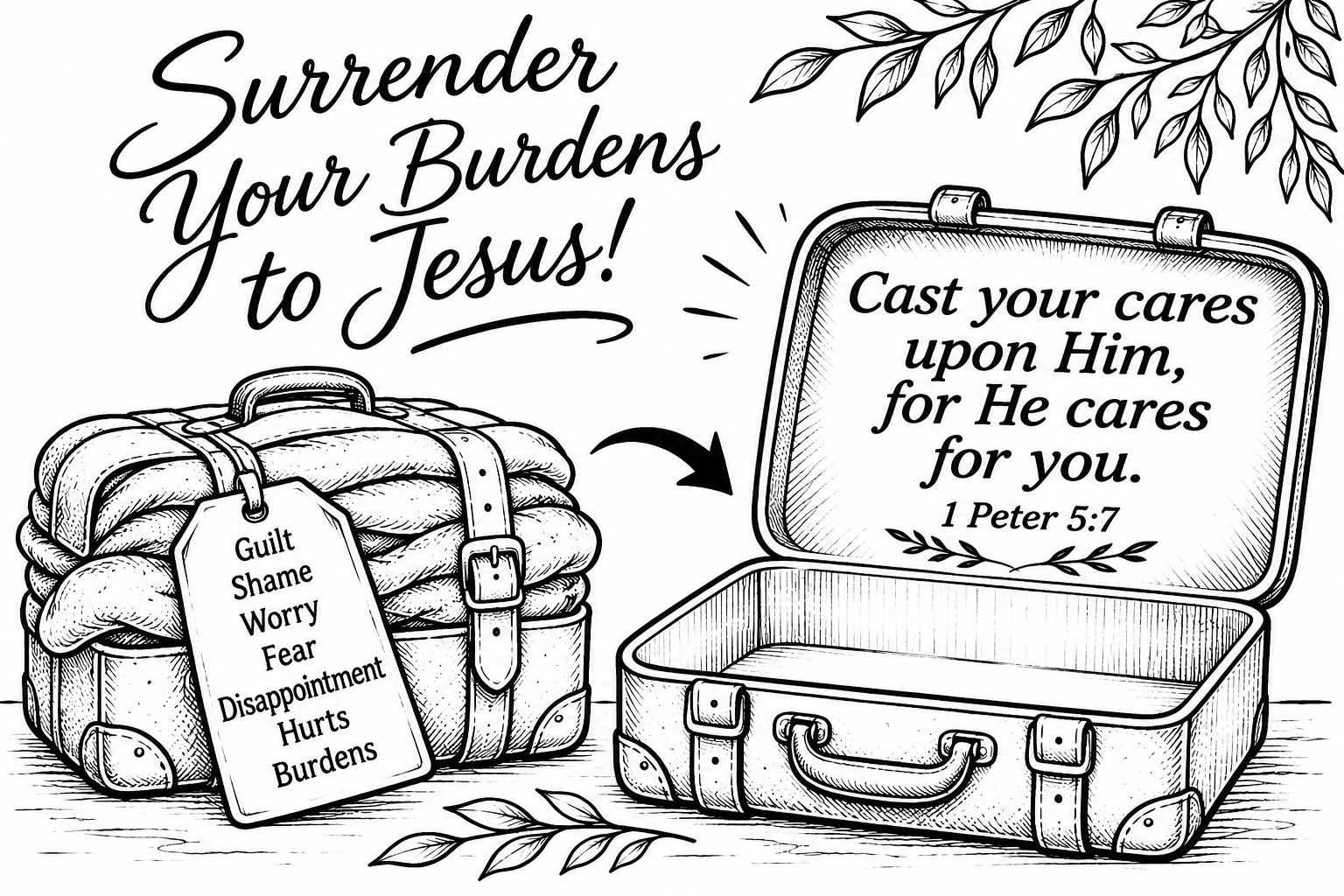
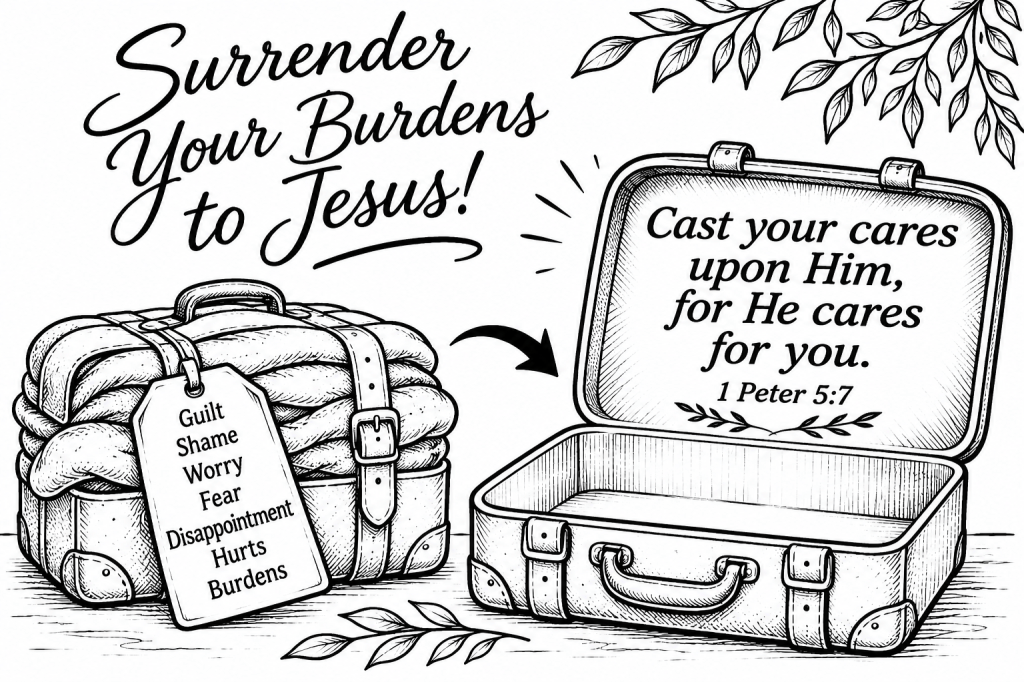
Here’s an illustration that may help you understand more clearly. Imagine carrying a suitcase that represents all the guilt, shame, painful memories, disappointments, and burdens you’ve accumulated throughout your life. Every time you refuse to surrender something to Jesus, it’s as though you’re adding another item to that suitcase. Over time, it becomes so full and heavy that you can barely lift it, much less carry it!
But here’s the wonderful thing about Jesus. He invites us to bring every one of those burdens to Him. And when we finally surrender them, it’s as though we’re opening that suitcase and emptying its contents at His feet.
Now think about this: If the suitcase is empty, why would we continue struggling to carry it around? There’s nothing left inside! Yet how often do we find ourselves picking those same burdens back up, allowing them to weigh us down all over again?
This is why learning to trust Jesus is so important. Surrender requires more than simply acknowledging that He is able to carry our burdens. It means believing that He cares for us enough to take them and that we can safely leave them in His hands.
A mind that is firmly fixed on Jesus is one that rests in the assurance of His faithfulness. It trusts that His promises are true, that He hears our prayers, and that no matter what difficulties we encounter, He will never leave us or forsake us.
And this brings us to something especially meaningful about Isaiah 26:3. The verse doesn’t simply tell us to keep our minds fixed on God. It also reveals why we can experience His perfect peace: “because he trusteth in thee.”
The word trust in Isaiah 26:3 comes from the Hebrew word batach, which conveys a sense of confidence, security, and complete reliance. This isn’t a hesitant or uncertain kind of trust. It’s the kind of assurance that allows us to rest securely in the Lord, knowing that He is faithful and completely worthy of our confidence.
A Hebrew word study by Chaim Bentorah entitled Welded to God — Betach highlights some amazing details worth noting. Bentorah draws an interesting connection between the Hebrew word batach and the process of welding two pieces of metal together.
Now, this is where it becomes quite eye-opening! When two pieces of metal are welded together, intense heat causes them to fuse, creating a bond so strong that they are not easily separated. The whole purpose of welding is to join two separate pieces into one strong connection.

Trusting God – Trusting Jesus
Bentorah uses this picture to illustrate the kind of trust we should have in God. Imagine being so completely joined to the Lord that your confidence in Him becomes unshakable! No matter what circumstances arise, you remain firmly attached to the One who is your refuge and strength. What a beautiful picture of what it means to dwell in the shelter of the Most High!
And here’s something else I find fascinating. The very same Hebrew word, batach, appears in Psalm 91:2:
I will say of the LORD, He is my refuge and my fortress: my God; in him will I trust (batach), Psalm 91:2.
Do you see the connection? Isaiah tells us that perfect peace comes from keeping our minds stayed on the Lord because we trust Him. And here in Psalm 91, we are declaring that the Lord is our refuge and fortress, the very One in whom we place our trust!
So how do we keep our hearts and minds firmly anchored to Jesus? Through prayer, worship, listening to Christian music, fasting, studying God’s Word, fellowship with other believers, and intentionally tuning into the Holy Spirit throughout our day. Each of these practices helps us draw closer to the Lord, strengthen our relationship with Him, and remain sensitive to His voice and guidance.
We should also cultivate an “attitude of gratitude,” by regularly thanking Jesus for all He has already done and trusting Him for what He will do in the future. Gratitude helps shift our attention away from the uncertainties of life and toward the faithfulness of God. Rather than becoming consumed by everything that could go wrong, we begin to remember all the ways He has already demonstrated His love, provision, and faithfulness. And the more we reflect on what He has done, the more confident we become in what He is able to do, regardless of the circumstances we may be facing.
With Thanksgiving just around the corner, it’s a great time to start a gratitude journal. I know that might sound a little cliché, but taking a few moments each day to write down the things you’re thankful for can make a meaningful difference in how you think and how you approach your life. It’s a simple yet powerful way to redirect your attention away from what’s troubling you and toward the many blessings God has already provided. In doing so, we are intentionally bringing our thoughts back to what is true, honorable, right, pure, lovely, and worthy of praise (Philippians 4:8).
Keeping our minds fixed on Jesus isn’t merely a suggestion. It’s essential if we want to walk in victory, remain grounded in God’s truth, and experience the perfect peace He has promised us!

